Starborn – Describe an app, AI builds it with auth, database, and AI tools included
Starborn – Describe an app, AI builds it with auth, database, and AI tools included: Describe a member portal, tracker, quiz, or custom AI tool your users...
Key takeaways
- Use this as a buyer-focused guide for ai tools, not just a trend summary.
- Compare workflow fit, pricing risk, integrations, and alternatives before trying another tool.
- Check the FAQ section for final decision points before shortlisting.
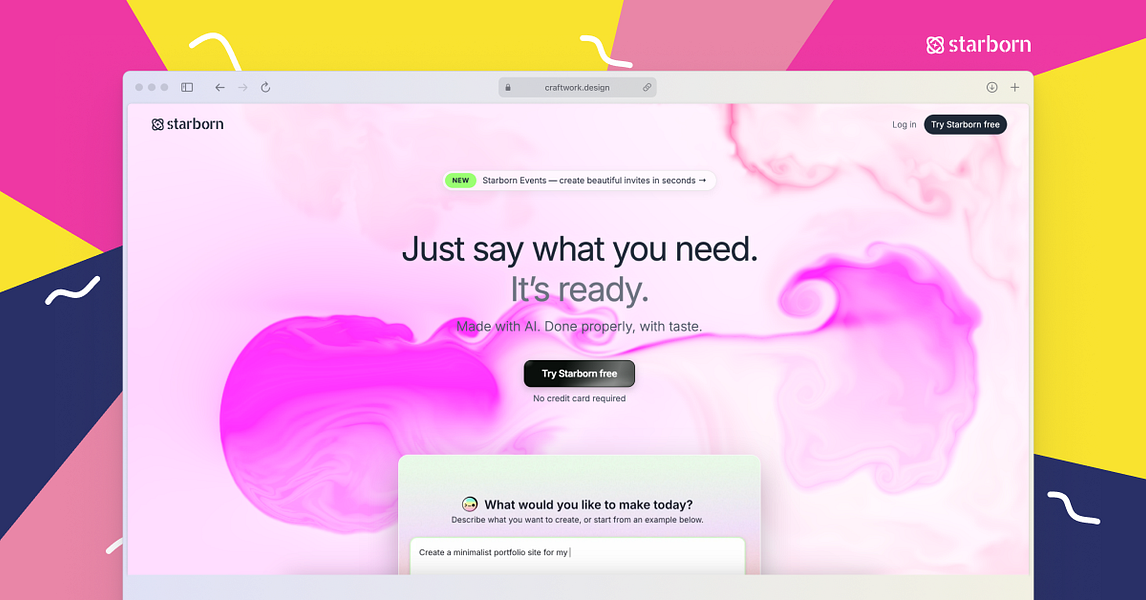
Starborn is an AI app builder aimed at makers who want to create interactive products rather than simple static pages. According to its BetaList listing, users describe an app idea such as a member portal, tracker, quiz, or custom AI tool, and Starborn builds an app with core product infrastructure included.
The key positioning is practical: instead of starting with a landing page and adding serious application features later, Starborn includes authentication, a database, file uploads, and multi-model AI as part of the app-building workflow. For solo founders, indie hackers, and non-technical operators, that could reduce the gap between “prototype” and “usable product.”

What Starborn is designed to build
Starborn is not described as a general website builder for brochure sites. The BetaList listing frames it as a builder for apps that users can interact with. Example use cases include:
- Member portals where users log in and access personalized content or tools.
- Trackers for collecting, storing, and reviewing user-entered data.
- Quizzes that require interaction, scoring, or user-specific results.
- Custom AI tools that let users interact with AI functionality inside an app-like experience.
That distinction matters for buyers. Many AI site builders can generate attractive pages quickly, but a real app usually needs user accounts, persistent data, uploads, and backend logic. Starborn’s pitch is that these are included from the start.
Core features listed for Starborn
| Feature | Why it matters for buyers |
|---|---|
| AI app generation from a description | Useful for makers who want to explain the product they need instead of assembling every screen and workflow manually. |
| Authentication | Supports products where users need accounts, login, or private access. |
| Database | Enables apps to store and retrieve user data instead of acting like static pages. |
| File uploads | Important for apps that collect documents, images, media, or user-submitted assets. |
| Multi-model AI | Suggests support for AI-powered functionality beyond a single fixed model, though the listing does not specify which models are available. |
| Human engineer help | When users get stuck, a human engineer can fix issues for $25 per request, according to the BetaList listing. |
Where Starborn may fit best
Starborn looks most relevant for buyers who already know the type of interactive tool they want to ship but do not want to start with a full engineering setup. The strongest fit appears to be early product validation, internal tools, lightweight SaaS prototypes, and user-facing AI utilities.
Good-fit users
- Indie makers who want to move beyond a landing page and test a working product idea.
- Startup founders validating a member portal, AI workflow, tracker, or quiz before hiring a full development team.
- Creators and educators building gated resources, assessments, or interactive learning tools.
- Consultants and agencies who need to deliver small custom AI apps or operational tools for clients.
- Product managers who want a faster way to prototype an app experience with real data and login flows.
Less ideal users
- Teams that only need a marketing site; a simpler website or landing page builder may be enough.
- Companies with strict compliance requirements; the source listing does not provide security, hosting, compliance, or data residency details.
- Buyers needing deep custom engineering; Starborn may help create a functional starting point, but complex products may still need dedicated developers.
- Procurement-led teams that require detailed pricing, service-level agreements, or enterprise controls; these are not described in the source listing.
Workflow value: why built-in infrastructure matters
The practical appeal of Starborn is that it treats common app requirements as first-class features. In many no-code or AI site workflows, makers can quickly generate screens but later discover that user accounts, storage, uploads, and AI integrations require separate tools, plugins, or custom code.
Starborn’s listing specifically says auth, database, file uploads, and multi-model AI are included instead of added later. If delivered well, that could shorten the path from concept to interactive product.
For buyers, the important question is not whether Starborn can generate a nice interface. It is whether the included infrastructure is enough to support the first real version of the product you want users to touch.
This makes Starborn potentially useful when the goal is to test behavior, not just interest. A landing page can measure signups. An interactive app can show whether users actually complete a workflow, upload files, answer questions, return to a dashboard, or engage with an AI feature.
Pricing and support considerations
The only concrete cost mentioned in the BetaList source is support-related: when users get stuck, a human engineer can fix it for $25 per request. That is notable because many AI builders leave users to troubleshoot prompts, generated code, or broken workflows on their own.
However, buyers should treat pricing as an open question. The listing does not provide full subscription plans, usage limits, hosting costs, AI model usage fees, database limits, storage limits, or export terms. Before relying on Starborn for a customer-facing product, ask:
- What is included in the base plan?
- Are there limits on users, database records, file storage, or AI usage?
- Which AI models are available under “multi-model AI”?
- Can apps be exported, self-hosted, or migrated later?
- What happens if an app scales beyond the initial prototype stage?
- How are authentication, user data, and uploaded files secured?
- What exactly qualifies as a $25 engineer fix request?
Starborn compared with nearby alternatives
The BetaList page lists several startups that may appeal to similar buyers, including Agent Builder, Spawnbase, TalktoBuild AI, Empromptu.ai, Instance, and Mocha. The source does not provide detailed feature-by-feature comparisons, but the positioning gives useful clues about where Starborn sits.
| Tool/category | Likely buyer focus based on listed positioning | How Starborn differs based on available source details |
|---|---|---|
| Traditional website builders | Marketing pages, portfolios, basic websites | Starborn is positioned for real interactive apps, not static pages. |
| AI landing page builders | Fast idea presentation and lead capture | Starborn emphasizes auth, database, file uploads, and AI tools as built-in app components. |
| Agent builders | AI agents and automated responses | Starborn’s described use cases include broader app types such as portals, trackers, quizzes, and custom AI tools. |
| No-code app builders | Visual app development without traditional coding | Starborn’s pitch centers on describing the app and having AI build it, with human engineer help available per request. |
Shortlist Starborn if...
- You want to build an interactive product rather than only a website.
- Your idea needs login, stored user data, uploads, or AI interactions.
- You are validating a SaaS, portal, tracker, quiz, or AI tool and need something users can actually try.
- You value the option of paid human engineering help when the AI-generated build gets stuck.
- You are comfortable clarifying pricing, limits, and deployment details before committing.
Be cautious if...
- You need published enterprise pricing or formal implementation terms before evaluation.
- Your app will handle sensitive data and you need documented compliance controls.
- You expect complex custom logic, advanced permissions, or large-scale production architecture immediately.
- You need guaranteed export, self-hosting, or long-term code ownership and those terms are not confirmed.
Buyer verdict
Starborn is worth shortlisting if your main problem is getting from an app idea to a working interactive product with core infrastructure already present. Its clearest value is for makers who do not want to stitch together authentication, database storage, file uploads, and AI functionality after generating a basic interface.
The biggest unknowns are commercial and operational: full pricing, AI usage limits, deployment model, security posture, and scalability are not detailed in the source listing. The $25 per request human engineer fix is a useful support signal, but buyers should clarify what it covers before depending on it for production work.
For early-stage builders, Starborn’s promise is straightforward: describe a member portal, tracker, quiz, or custom AI tool, and use AI to produce something closer to a real app than a static page. If that matches your workflow, it is a practical tool to evaluate alongside no-code app builders and AI agent builders.
Evaluation criteria
How to use this guide before buying software.
FAQ
How should I evaluate Starborn – Describe an app, AI builds it with auth, database, and AI tools included?+
Evaluate Starborn – Describe an app, AI builds it with auth, database, and AI tools included through workflow fit, pricing risk, integrations, alternatives, and whether it improves a real ai tools use case.
What should I compare before buying an AI or SaaS tool?+
Compare the product against direct competitors, built-in features inside tools you already use, and the current manual workflow before choosing a paid plan.
When should I skip a trending tool?+
Skip it when the use case is unclear, pricing limits are hard to verify, or the product duplicates a workflow your existing stack already handles well.